From the Ground(hogs) Up
Following the path of Tony (T.S.) McPhee from 1964 with John Lee Hooker to 1967 with Champion Jack Dupree to a 1973 art-rock suite about fox hunting.

They’re not sure how to dance to it. There’s trepidation in some faces when a camera from BBC-TV’s The Beat Club finds them – perhaps they’re not moving enough, or they’re somehow moving incorrectly. Tell us if we’re doing it wrong, a few seem to plead. It’s 1964, and that means extreme black and white closeups of the guitar fretboard, the head of the snare drum, the methodical up-and-down click of the hi-hat, the ever-worried brow of John Lee Hooker.
Sure, it’s not the dancing you’d see at a jukejoint in Clarksdale Mississippi. Still what a sight: A whole dancefloor moving in response to Hooker’s signature “Boom Boom,” with young Hooker doing the thing with help from a band of earnest young white musicians known as the Groundhogs. Who understand enough about the blues to keep the groove spare and steady.
Must have been wild times in London and environs during the blues revival that began in 1963-1964. Bands like the Rolling Stones formed with the righteous mission of covering and championing American blues from a generation or two previous. That renewed long-dormant interest in veteran Mississippi Delta artists, and others who could be promoted as “authentic” blues voices. At that time, Delta artists who are now revered as legends – Hooker, Son House, Muddy Waters and others — were not legends. They didn’t or couldn’t tour widely in the U.S. They were in some cases careerless, doing other things, their recordings a part of the past. And then, out of nowhere, they found themselves beloved by young people in the UK and Europe.
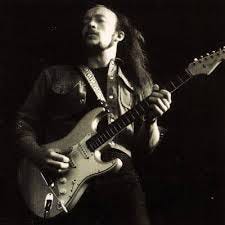
The embrace became something more musically consequential than a crazy new teen trend: It magnetized musicians to cities like London – John Mayall moved there in 1963 and immediately formed his (enduring, intense) band the Bluesbreakers. New bands (see: The Yardbirds, the Animals) emerged to meet a growing demand. Plus the Delta veterans toured, and that meant backing-band opportunities for young blues-obsessed musicians like guitarist and songwriter Tony McPhee of the Groundhogs (above).
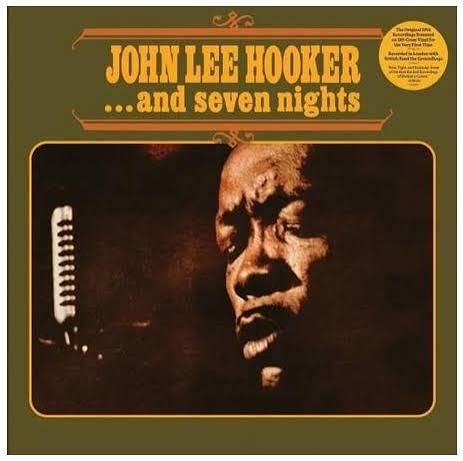
And that meant a rare type of on-the-job experience we don’t see much anymore. Perhaps this wasn’t “mentorship” in common Human Resources usage, but it offered alert musicians opportunities to absorb the nuances of blues performance – the slight shuffle in the backbeats, the short melodic phrases that signal the end of a chorus. McPhee was evidently a fast learner: Check out the carefully calibrated pitch-bending in “No One Pleases Me But You,” from Hooker’s 1966 studio album ….And Seven Nights.
That record is entrancing the whole way; the band aligns behind Hooker’s canting vocals, supplying raw, visceral energy instinctively. Hooker spoke glowingly of McPhee and the Groundhogs; he requested them as his backing band on subsequent European tours, and in an interview described them as “the number one British blues band.” Didn’t take long before other American blues artists sought them out: During the ‘60s the Groundhogs also backed Little Walter, Jimmy Reed and Memphis Slim.
Here’s another bluesman who became a McPhee fan: The slippery-fingered blues pianist and singer Champion Jack Dupree. Somewhere in the middle of the guitar solo in “Snow Is On the Ground,” one of a series of intimate duets with Dupree singing and McPhee playing, Dupree addresses whomever might be listening: “That sound good, don’t it? That sound good!”
Sure enough it does. The record, Dupree & McPhee: The Blue Horizon Session, is a discographical oddity. It was produced by veteran Mike Vernon, who suggested that McPhee add the initials “T.S.” (for “Tough Shit”) to his name – presumably to make him seem more authentically “of” the blues. At the time of recording, the New Orleans-born Dupree was known as a blues pianist – but he only sings on The 1967 Blue Horizon Session. McPhee provides all the (terse, apt, agile) accompaniment.
Celebrating the more introspective shades and hues of the blues, this set is a stone-cold killer. It was recorded in 1966-67, so it’s just a few years after McPhee first played with John Lee Hooker. But it was not released until 2005 – on the British Ace label, with little international fanfare. The guitarist is clearly in control of all the blues fundamentals, and comfortable stretching them with thoughtful, sometimes weeping little asides. Dupree sounds like he’s doing more than reminiscing about his favorite homemade jug whiskey; check out his laconic stroll through the relaxed zen lesson “Easy Is the Way.”
An inspiring thing about Tough Shit McPhee: After being an apprentice and absorbing many of the unspoken intricacies of the blues, he didn’t just ride the revival train for the rest of his career. He reformed the Groundhogs as a power trio and in 1969 set out to reframe blues tropes with the intense and occasionally irreverent Blues Obituary. Then McPhee steered the band toward progressive rock, in ways that retained, and then twisted apart, blues-based riffage. Here’s “Cherry Red” from 1971’s terrific Split.
And then in 1973 McPhee released a solo album, The Two Sides of Tony (T.S.) McPhee, which belongs to the long tradition of albums expressing two polar-opposite musical personalities. Side A is throttling blues-rock and Side B is a meandering 20-minute synth-heavy progressive rock suite that finds McPhee railing at the British aristocracy’s tradition of fox hunting.
This track might not have been the evolutionary step McPhee’s reverent fans wanted. But credit McPhee for the leap, which in spirit and scope is similar to Hooker’s late-career experiments – the metaphysical 1989 The Healer and the transfixingly murky collaboration with Miles Davis, The Hot Spot, the soundtrack to Dennis Hopper’s noirish 1990 film of the same name. The blues inspires an insular kind of repertory reverence today; it’s heartening that some of its prime movers, originators and one-time apprentices alike, avoided that particular easy route.